About the Journal
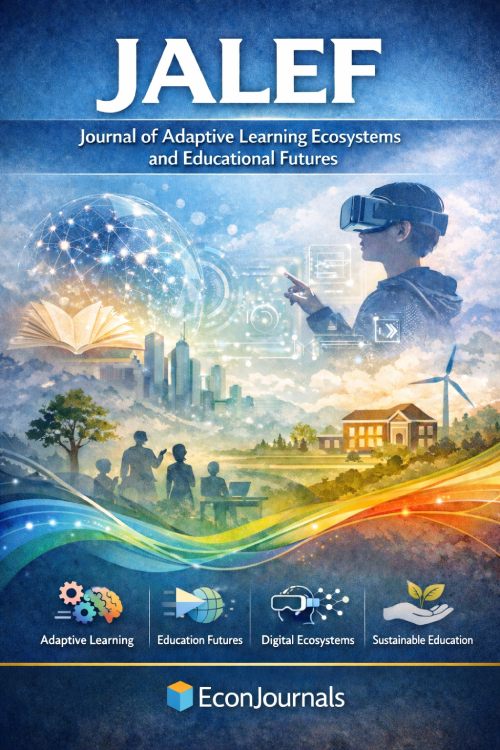
Journal of Adaptive Learning Ecosystems and Educational Futures (JALEF) focuses on the transformation of education through dynamic, interconnected, and future-oriented systems. It publishes high-quality empirical, theoretical, and interdisciplinary research that explores how education evolves in response to technological, social, economic, and environmental change.
The journal emphasizes education as an ecosystem, integrating learners, institutions, technologies, policies, and communities into adaptive and responsive frameworks.
Key Thematic Areas
- Adaptive & Personalized Learning Systems
- AI-driven and data-informed education
- Learning analytics and predictive modeling
- Personalized curriculum design
- Education Futures & Foresight
- Scenario planning and future-of-education studies
- Skills for uncertain and rapidly changing labor markets
- Lifelong learning frameworks
- Digital & Hybrid Learning Ecosystems
- Blended, online, and immersive learning environments
- Metaverse and virtual reality in education
- Platform-based education models
- Policy, Governance & Educational Innovation
- Education policy in the digital age
- Institutional transformation and governance models
- Global and comparative education systems
- Sustainability & Resilient Education Systems
- Education for sustainable development (ESD)
- Crisis-responsive education (pandemics, conflict, climate change)
- Equity, access, and inclusion in evolving systems
- Human-Centered Learning Design
- Cognitive, emotional, and social dimensions of learning
- Student engagement and motivation
- Inclusive and culturally responsive pedagogy
7. Digital Transformation in Education & Human Development:
- AI in Education.
- Adaptive & Personalized Learning.
- Learning Analytics.
- Virtual & Smart Classrooms.
- Digital Pedagogy.
- Gamification & Augmented Learning.
- Online Assessment Systems.
- Cloud-Based Learning Environments.
PUBLICATION FREQUENCY
The journal is published Quarterly (4 issues per year: January, April, July, October).
OPEN ACCESS POLICY
This journal provides immediate OPEN ACCESS to its content on the principle that making research freely available to the public supports a greater global exchange of knowledge. All articles published by TP are made immediately available worldwide under an open access license. This means that everyone has free and unlimited access to the full-text of all articles published.
Open Access business model is adopted by TP.
ARCHIVING
This journal utilizes the LOCKSS system to create a distributed archiving system among participating libraries and permits those libraries to create permanent archives of the journal for purposes of preservation and restoration. More...